Last updated June 30, 2026
Garage Door Permits, Codes & Inspections in FL: What You Need to Know
Most homeowners in Orlando treat a garage door replacement like swapping out a kitchen faucet — something a contractor handles quietly and quickly, no paperwork required. But Florida operates under one of the strictest building code frameworks in the country, shaped by decades of hurricane damage and the hard lessons that followed. The result is a permit-and-inspection system that catches a surprising number of homeowners off guard, sometimes years after the work is done. This guide explains exactly where the line is drawn in Orange County, what the Florida Building Code actually requires, and how to avoid the six-week closing nightmare that tripped up a Windermere homeowner when an unpermitted door nearly killed her sale.
Quick Answer
In Florida, a permit is required for any garage door replacement — not just new construction — because the door must be verified as compliant with the Florida Building Code’s wind-load standards for your specific wind zone. In Orange County, that requirement is enforced under Florida Statute 489 and the 2023 Florida Building Code. Skipping the permit doesn’t just risk a fine; it can void your homeowner’s insurance and flag as an open code violation on a title search when you sell.
Table of Contents
- Florida Statute 489: What Triggers a Permit for Garage Door Work
- Wind-Load Compliance Under the 2023 Florida Building Code
- How Orange County Enforces These Rules (and Where It Goes Further)
- What a Retroactive Permit Actually Costs vs. Pulling It Upfront
- How to Check Whether a Prior Owner’s Garage Door Work Was Permitted
- What Inspectors Look for During a Garage Door Inspection
- Common Mistakes to Avoid
- When to Call a Professional
Florida Statute 489: What Triggers a Permit for Garage Door Work
Florida Statute 489 governs construction contracting statewide and draws a clear line between work that requires a licensed contractor and a permit, and work that a homeowner or handyman can do without one. For garage doors, the statute works alongside the Florida Building Code to define “alteration” — and in Florida, replacing a garage door panel assembly qualifies as an alteration to the building envelope.
Here’s the practical breakdown of what does and doesn’t require a permit in Orange County:
- Requires a permit: Full garage door replacement (door panels, tracks, and hardware as a system), installation of a new garage door in a previously open bay, and any structural modification to the door opening’s rough framing.
- Does NOT require a permit: Like-for-like spring replacement, cable repair, roller and hinge replacement, opener installation or swap-out (in most Orange County jurisdictions — see below), and minor weatherstripping or bottom seal replacement.
- Gray area that often does require a permit: Replacing only the door panels (skins) while leaving the original frame, if the original door was not wind-load rated to current code. Orange County inspectors have flagged this scenario repeatedly.
The critical takeaway: the moment you change the door itself — the movable panel assembly — you’ve triggered the permit requirement, because the county needs to verify the replacement door carries the correct wind-load certification label for your address’s wind zone. This is different from most Northern states, where door replacements are routinely done without permits. Florida is not most states.
One nuance worth knowing: homeowner-owner-builder permits are available in Florida, meaning you can pull the permit yourself without a licensed contractor. But you must own and occupy the property, and you become personally responsible for code compliance — which circles back to wind-load ratings, discussed next.
Wind-Load Compliance Under the 2023 Florida Building Code
Florida’s wind-load requirements for garage doors exist because a garage door is the single largest opening in most residential structures. When a door fails in a high-wind event, the resulting pressure differential can lift the roof. After Hurricane Andrew in 1992 and again after the 2004 hurricane season devastated Central Florida, the Florida Building Commission progressively tightened the standards to where they stand today under the 2023 FBC (Florida Building Code, 7th Edition).
For Orlando and Orange County specifically, the relevant wind-speed design criteria fall under ASCE 7-22, which the 2023 FBC adopts. Most of Orlando sits in a 130 mph ultimate design wind speed zone (some southeastern edges of the county push into 140 mph territory). Every replacement garage door must carry a product approval number issued by the Florida Department of Business and Professional Regulation (DBPR) and must be installed in strict accordance with that approval’s listed installation instructions.
What this means practically when you’re shopping for a replacement door:
- The door must have a Florida Product Approval (FL#) number on file with the DBPR. Clopay and Wayne Dalton, for example, list their approved products in the DBPR’s online database with the specific wind pressures each model is rated for.
- The approval lists the exact fastener schedule, track gauge, bracket type, and strut reinforcement required for the door to meet its rated wind load. Substituting a cheaper bracket or skipping a mid-span strut voids the approval and creates a code violation even if the door itself is rated correctly.
- The installer must leave the product approval document (or a copy) on site for the inspector.
- Steel doors in the 130 mph zone typically require 2-inch steel tracks minimum; many economy-grade doors sold nationally don’t qualify for Florida installations.
In our experience, the most common wind-load failure we’ve seen across Orlando installations isn’t the door itself — it’s the end-stile brackets and the bottom corner hardware, which are frequently under-specified by contractors who aren’t Florida-specific in their training. Getting this right upfront is why pulling the permit and passing inspection actually protects you.
How Orange County Enforces These Rules (and Where It Goes Further)
Orange County’s Building Division administers permits under the 2023 FBC with local amendments adopted by the Board of County Commissioners. The county also falls under the jurisdiction of several incorporated municipalities — the City of Orlando, Winter Park, Ocoee, and others — each of which may add their own administrative requirements on top of the state code, though the structural wind-load standards themselves are set at the state level and cannot be locally weakened.
A few Orange County-specific enforcement realities worth knowing:
- Permit fees: As of 2025, a residential garage door replacement permit in unincorporated Orange County runs approximately $100–$175 depending on the door’s declared value. The City of Orlando’s fee schedule is similar but calculated slightly differently — typically $125 for a single residential door replacement.
- Inspection scheduling: Orange County requires the inspection to be requested online through the county’s permitting portal (OrangeCountyFL.net) and typically schedules within 2–5 business days. Same-day or next-day inspections are rare unless you use the county’s expedited review fee.
- HOA intersections: Neighborhoods like Windermere, Dr. Phillips, and Isleworth have active HOAs that may require design approval separately from the county permit. The county permit does not supersede HOA restrictions on door material, color, or panel style.
- Open permits from prior owners: Orange County’s permit portal shows open (uninspected) permits tied to a property address. Buyers’ agents have started running these searches routinely — an open permit from 2019 on a garage door job will surface and can delay or derail a sale.
One pattern we’ve noticed across Orlando properties built in the 1990s: the original garage door was installed under a certificate of occupancy that predates current wind-load standards. Replacing that door — even with an identical-looking product — requires the new door to meet current code, not the code that was in effect when the house was built. This trips up homeowners in established neighborhoods like Conway, Pine Hills, and Hunters Creek regularly.
What a Retroactive Permit Actually Costs vs. Pulling It Upfront
This is where skipping the permit gets expensive. If unpermitted garage door work is discovered — whether by a neighbor’s complaint, a homeowner’s insurance audit, or a title search during a sale — you’ll need a retroactive (after-the-fact) permit, which Orange County calls a Notice of Commencement after Work Has Started.
Here’s a realistic cost comparison:
| Scenario | Typical Cost in Orange County |
|---|---|
| Standard permit pulled upfront | $100–$175 (permit fee only) |
| Retroactive permit — door is still compliant and accessible | $250–$400 (double-fee penalty + inspection) |
| Retroactive permit — door fails inspection (wrong wind rating) | $1,500–$4,500+ (new compliant door + reinstallation + re-inspection) |
| Retroactive permit discovered at closing — buyer’s lender demands repair before close | $2,000–$8,000+ (rush labor premium, closing delay costs, potential price renegotiation) |
The Windermere closing scenario referenced at the top of this guide is not an outlier — it’s a pattern. The six-week delay that homeowner experienced came from three compounding factors: the retroactive permit application itself (10 business days minimum), the failed wind-load inspection on the original replacement door (it was rated for 110 mph, not the required 130 mph), and the additional time required to source and install a Florida-compliant Clopay door that matched the home’s aesthetic well enough to satisfy the HOA. The total out-of-pocket cost to the seller was over $4,200.
Pulling the permit upfront on that job would have cost $140.
How to Check Whether a Prior Owner’s Garage Door Work Was Permitted
Orange County makes this searchable through its public permitting portal. Here’s exactly how to do it:
- Go to Orange County’s online permitting portal at permits.ocfl.net (search “Orange County FL building permits” if the URL has changed — the county updates its platform periodically).
- Select “Permit Search” and enter the property address. You don’t need an account to search.
- Filter by permit type: select “Building” and look for entries categorized as “Residential Alteration” or “Garage Door” — the county’s coding varies slightly by year, so scan all building permits issued for the address.
- Check the status field: “Finaled” means the inspection passed and the permit was closed. “Issued” or “Open” means the permit was pulled but never inspected — arguably worse than no permit in some ways, because it’s a confirmed open code item on record.
- If you find no permit for a garage door that is clearly a replacement (different style, newer hardware, or a different brand label than the original construction documents), that’s a red flag worth investigating before listing or buying.
- For properties within the City of Orlando’s jurisdiction (as distinct from unincorporated Orange County), use the City of Orlando’s Energov portal at orlando.gov/permits instead — the county and city maintain separate permit databases.
If you’re buying a home in Lake Nona, Metrowest, or Baldwin Park, confirm which jurisdiction the address falls under before searching — some neighborhoods straddle county and city lines in ways that aren’t obvious from a zip code alone.
What Inspectors Look for During a Garage Door Inspection
Understanding what the Orange County inspector will verify helps you — or your contractor — install the job so it passes on the first visit. A re-inspection fee in Orange County runs approximately $75, and scheduling a second visit adds days to the project timeline. Here’s what the inspector is checking:
- Florida Product Approval (FL#) label on the door: The door itself must have the approval label affixed — usually on the top section. If the installer removed it or it was never there, the inspection will fail immediately.
- Product approval document on site: The installer must leave a copy of the DBPR product approval sheet listing the approved installation method. The inspector cross-references the label number against this document.
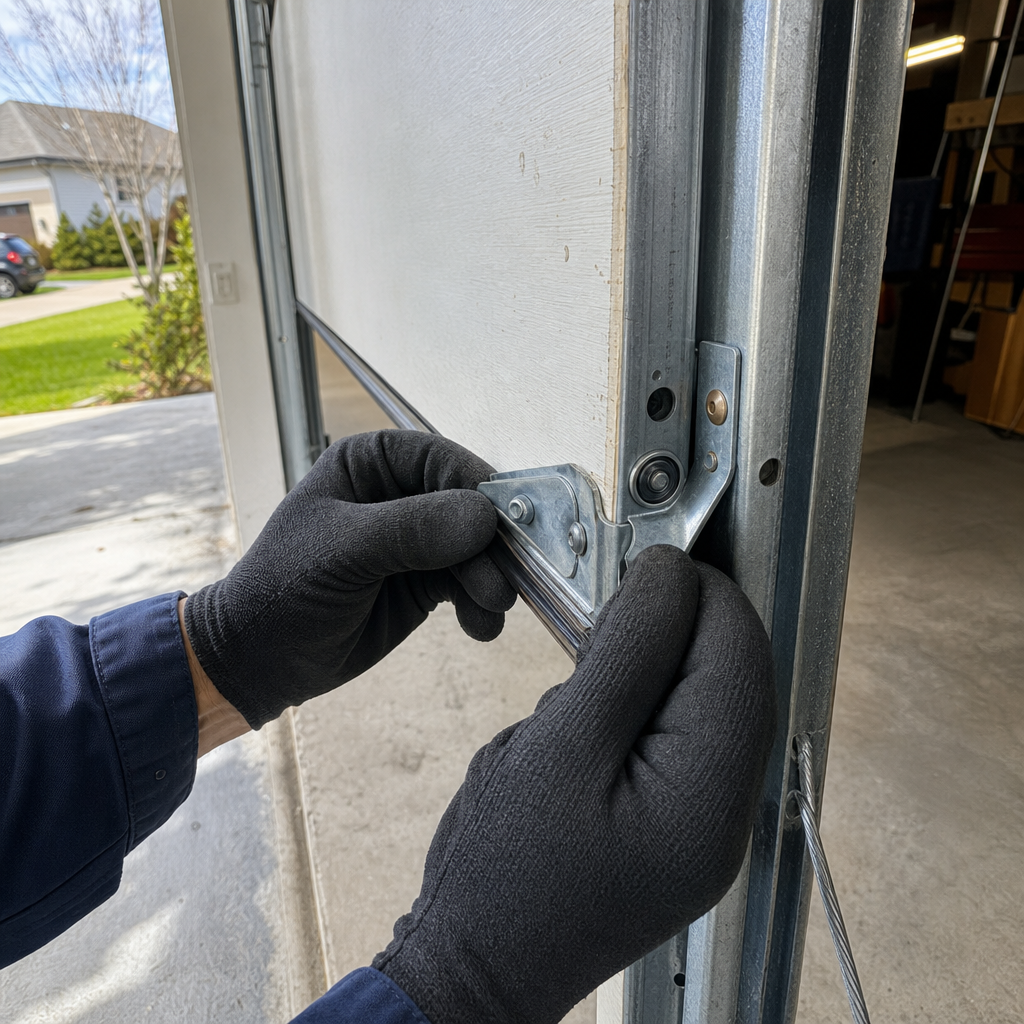
- Track gauge and mounting: The inspector will verify that the track bracket size and fastener schedule match what the product approval specifies. Under-sized brackets are the most common first-visit failure we’ve seen across Orlando jobs.
- Strut reinforcement: Doors wider than 9 feet typically require horizontal struts across the door sections at specified intervals. The inspector will confirm the number and placement of struts matches the product approval’s requirement for your door’s width and height.
- Bottom corner hardware and cable drums: These are load-bearing components in a wind event. Inspectors check that they meet the product approval specs — not that they simply “look sturdy.”
- Header clearance and spring assembly: The spring system (torsion or extension) must be installed with proper clearances and safety containment per FBC requirements. A note on safety here: torsion springs operate under extreme tension — if the system looks incorrect or damaged, do not attempt to adjust it yourself. This is a job for a trained technician, not a DIY fix before an inspection.
- Permit card posted: The permit card (or its digital equivalent, now accepted in Orange County) must be visible at the job site during inspection.
One preparation tip: when the installer completes the job, photograph the product approval label on the door, the bracket hardware, and the strut placement before closing the door fully. If a re-inspection is needed weeks later, that documentation speeds the process considerably.
Common Mistakes to Avoid
- Assuming “they’ve done it a thousand times without a permit” means it’s fine. In Florida, the enforcement isn’t random — it’s triggered by title searches. A contractor’s track record of skipping permits doesn’t protect you when your buyer’s lender flags an unpermitted replacement at closing.
- Buying a door not verified for Florida Product Approval before ordering. National big-box store displays frequently carry doors that are product-approved in Florida, but specific configurations (certain widths, insulation packages, or color options) sometimes don’t carry the FL# approval. Confirm the exact model and size are on the DBPR approval list before purchase.
- Treating an opener replacement as automatically permit-free. In most Orange County jurisdictions it is permit-free, but if the opener installation involves any electrical panel work, a separate electrical permit is required. LiftMaster and Chamberlain smart openers that require a new dedicated circuit trigger this requirement more often than older single-outlet installs.
- Relying on a contractor’s verbal assurance that they’ll “handle the permit.” Ask to see the permit number before work begins — not after. In Orange County, permits are pulled online and the number is issued within minutes of payment. There’s no legitimate reason a contractor can’t show you proof before the first screw is turned.
- Ignoring an “Issued” (open) permit on a property you’re purchasing. An open permit means the work was started but never inspected. The new owner inherits the obligation to close it — and if the work was done incorrectly, the new owner pays to fix it.
- Using out-of-state installation crews unfamiliar with FBC wind-load requirements. After major storms, out-of-state contractors sometimes work Orlando neighborhoods without understanding Florida-specific code. A door installed by a crew that doesn’t know what a Florida Product Approval number is will almost certainly fail inspection.
- Skipping the permit because the door “looks the same.” Visual similarity to the original door doesn’t mean wind-load equivalence. A builder-grade steel door from 2005 and a visually identical door sold today may have completely different structural specifications and Florida approval status.
When to Call a Professional
Call a licensed, Florida-experienced contractor when: you’re replacing the full door assembly (not just hardware); you’ve discovered an open or missing permit on a home you own or are buying; the door was installed after 2000 and you have no record of a permit; the door shows signs of structural damage from a storm event; or any component of the spring, cable, or bottom bracket system looks bent, cracked, or improperly seated. Spring and cable systems operate under significant stored energy — misaligned or damaged hardware is a serious safety hazard that should be evaluated by a trained technician, not adjusted by hand.
Majestic Garage Door Repair Orange County offers free estimates in Orlando — call (863) 588-3313 and Brian will walk you through exactly what your specific situation requires before any work begins.
Frequently Asked Questions
Yes — any full garage door replacement in Orlando and Orange County requires a building permit under the 2023 Florida Building Code. The permit triggers a wind-load compliance inspection, which verifies that the new door carries the correct Florida Product Approval for your address’s wind zone. Permit fees in unincorporated Orange County run approximately $100–$175. Call (863) 588-3313 for a free walk-through of what your specific replacement requires.
Opener-only installation typically does not require a separate permit in most Orange County jurisdictions, as long as the installation uses an existing outlet and doesn’t involve new electrical wiring. If the opener requires a new dedicated circuit or any panel work — common with some newer LiftMaster battery-backup systems — a separate electrical permit is required. When in doubt, confirm with the Orange County Building Division before starting work.
Most of Orlando falls within a 130 mph ultimate design wind speed zone under ASCE 7-22 as adopted by the 2023 Florida Building Code. Your replacement door must carry a Florida Product Approval (FL#) number verifying it meets that wind pressure rating at your door’s specific width and height. Some southeastern portions of Orange County are zoned at 140 mph — confirm your address’s wind speed designation through the Florida Department of Emergency Management’s wind speed lookup tool before ordering a door.
Search the Orange County permitting portal at permits.ocfl.net using your property address. Look for any “Residential Alteration” or garage door permits under the building category, then check whether the status shows “Finaled” (passed inspection) or “Open/Issued” (work never inspected). For properties within the City of Orlando’s limits, use the City’s separate Energov portal at orlando.gov/permits. If you find no record and the door is clearly a replacement, that’s worth investigating before a sale.
An unpermitted replacement will typically surface during a title search or a lender-required inspection. The buyer’s lender can require the issue be resolved before closing, which means pulling a retroactive permit, scheduling an inspection, and — if the door fails for wind-load compliance — replacing it with a code-compliant door at the seller’s expense. Total costs in this scenario commonly run $2,000–$8,000 depending on how urgently the work needs to be completed and whether the existing door passes or fails inspection. Pulling the permit upfront costs $100–$175.
Yes. Florida’s owner-builder exemption under Florida Statute 489 allows a homeowner who owns and occupies the property to pull a permit without a licensed contractor. You become personally responsible for ensuring the installation meets code — including wind-load compliance and correct installation per the door’s Florida Product Approval document. If you’re comfortable sourcing a Florida-approved door and following the product approval’s installation specifications exactly, this is a legal option. Most homeowners who attempt it hire a professional installer for the actual work while holding the permit themselves, which is also permitted.
The Bottom Line
Florida’s permit and wind-load requirements for garage doors aren’t bureaucratic friction — they’re the specific lessons the state learned from hurricanes that tore through Central Florida and left roofs exposed because garage doors failed first. In Orlando and Orange County, replacing a garage door without a permit is a short-term shortcut with a long-tail cost that shows up at the worst possible moment: the closing table. Pull the permit, verify the Florida Product Approval, pass the inspection, and you have documentation that protects your home’s value and your insurance coverage for as long as you own the property. Brian Johnson and the team at Garage Door Installation in Williamsburg and across Orange County have navigated these requirements on hundreds of Orlando installations — the permit process, done correctly, adds one inspection visit to the project timeline and nothing more.
For permit questions, free estimates, or help evaluating a door that may not have been installed to code, call (863) 588-3313. No pressure, no sales pitch — just a straight answer from someone who’s been doing this in Orlando since 2008.
Written by Brian Johnson, Owner & Lead Technician at Majestic Garage Door Repair Orange County, serving Orlando since 2008.