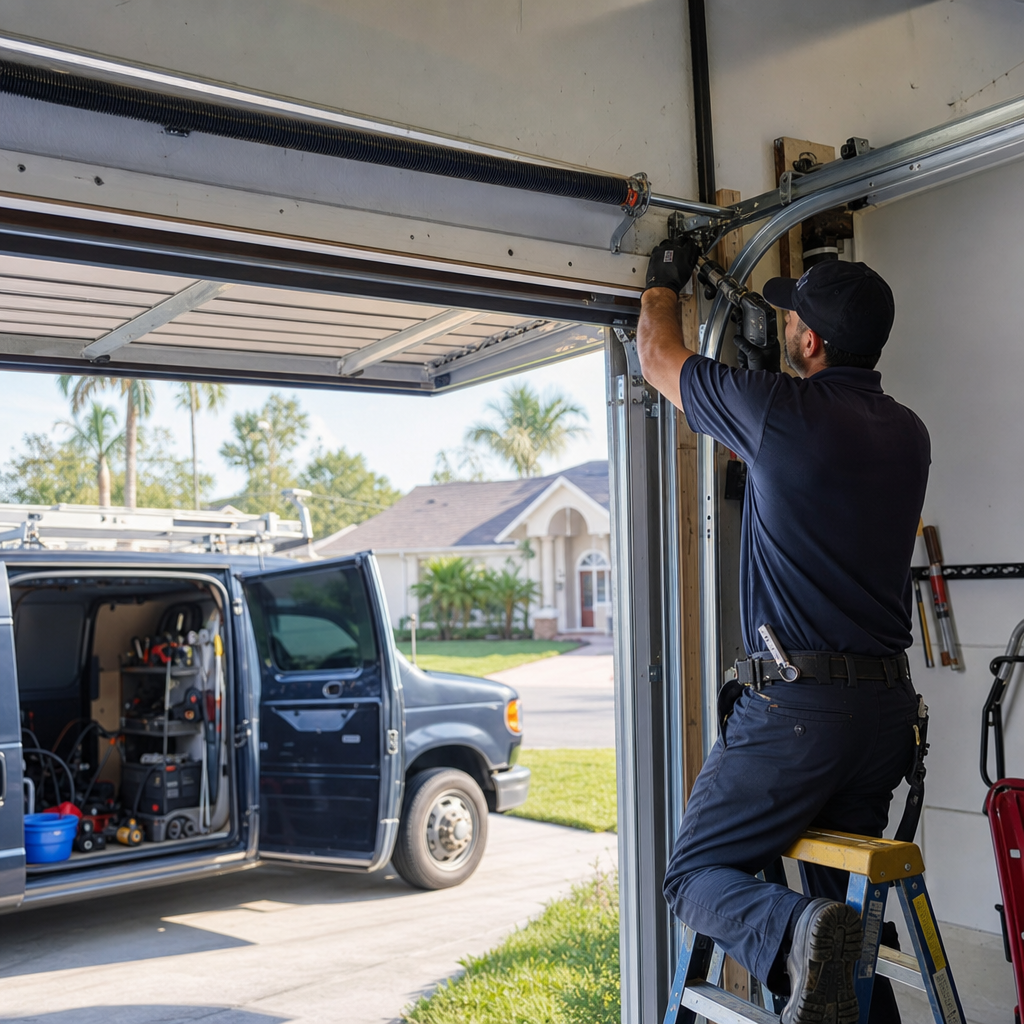
Last updated June 30, 2026
Garage Door Repair Maintenance Checklist for Orlando Homeowners
The maintenance schedule printed in your garage door opener’s manual was written for a four-season climate. In Orlando, the metal hardware inside a non-air-conditioned garage routinely hits 130°F on a July afternoon — and that single fact invalidates almost every interval on that list. Standard lithium-grease products liquefy and migrate off the tracks. Rubber seals that would last eight years in Ohio crack or deform here in three. Humidity that never fully leaves the air accelerates rust on torsion springs faster than any other region in the continental U.S. This guide sequences every maintenance task by Florida-specific failure rate, so you know exactly what to do first, how often to do it in Orlando’s climate, and what to skip doing yourself because the stakes are too high.
Quick Answer
An Orlando garage door maintenance checklist should prioritize monthly lubrication with a high-heat silicone or white lithium spray, a twice-yearly bottom-seal inspection for humidity and pest intrusion, and a post-storm spring-and-track visual check after every named tropical system. In Central Florida’s heat and humidity, most maintenance tasks need to happen two to three times more often than national guidelines suggest — and two specific tasks (spring inspection and cable check) should always be handed to a licensed technician because of the extreme tension involved.
Table of Contents
- Why Florida Heat Destroys the Wrong Lubricants — and What to Use Instead
- Spring Tension Visual Checks You Can Do Safely (Without Touching the Hardware)
- How to Test Your Bottom Seal for Humidity and Pest Intrusion
- The Two Inspection Items to Do After Every Named Tropical Storm
- Month-by-Month Orlando Maintenance Schedule
- Garage Door Opener Checks Every Orlando Homeowner Should Know
- Common Mistakes to Avoid
- When to Call a Professional
- Frequently Asked Questions
- The Bottom Line
Why Florida Heat Destroys the Wrong Lubricants — and What to Use Instead
This is the single biggest maintenance mistake we see across Orlando garages, from Ocoee to Lake Nona. Most homeowners buy a general-purpose WD-40 or a standard lithium-grease spray at the hardware store, apply it dutifully, and wonder why their door sounds worse six weeks later. Here’s what’s happening: WD-40 is a water displacer and solvent, not a lasting lubricant — it strips away residual grease and leaves the surface dry. Standard petroleum-based greases have a melting point around 250°F in a lab, but under continuous radiant heat from a metal track and Florida sun, they thin out, drip, and collect dust and debris, creating an abrasive paste that grinds against rollers and hinges.
What actually works in Orlando’s climate:
- 100% silicone spray — Stays stable well above 200°F, repels moisture, and doesn’t attract dirt. Use it on rollers, hinges, and the inside curve of the track.
- White lithium grease spray (not the paste in a tube) — Appropriate for the torsion spring coils and the drive rail of a screw-drive or chain-drive opener. The spray formulation stays where you put it better than paste in high-heat conditions.
- Avoid: petroleum-based black grease, 3-in-1 oil, and anything marketed as “all-purpose.” They all break down below the temperatures a July Orlando garage regularly hits.
Application frequency in Central Florida: every 60–90 days, not the six-month interval most manuals suggest. A quick five-minute spray on hinges, rollers, and the spring bar takes less effort than a service call — but it dramatically extends the life of every moving part.
Points to lubricate every 60–90 days:
- All hinges (inside fold, not the outside face)
- Nylon or steel rollers (stem only, not the track itself)
- Torsion spring coils (light coat, white lithium spray)
- Bearing plates on either side of the spring bar
- Lock bar and lock cylinder if you have a manual slide lock
Do not lubricate the inside surface of the track — that causes the rollers to slip rather than roll, which throws alignment over time.
Spring Tension Visual Checks You Can Do Safely (Without Touching the Hardware)
Safety notice first: Torsion springs and lift cables are under extreme mechanical tension — a snapped spring can release hundreds of foot-pounds of force in a fraction of a second, causing serious injury or death. The visual checks below are observation-only. If anything looks wrong, stop and call a trained technician. Do not attempt to adjust, loosen, or replace springs or cables yourself.
That said, you absolutely can and should observe your springs regularly. In Orlando’s humidity, torsion springs rust faster than almost anywhere else in the country. We’ve replaced springs in Windermere and Doctor Phillips that failed in under four years — roughly half the lifespan you’d expect in a drier climate — because surface rust went unnoticed until it compromised the coil.
What to look for (eyes only, door fully closed):
- Surface rust or pitting on the coils. A light orange tint is early-stage rust. Deep pitting or flaking means the spring’s tensile strength is already compromised. Either condition warrants a technician call.
- Gap in the coil. A healthy torsion spring is uniform, coil-to-coil. A visible gap — even a quarter-inch separation — means the spring has partially broken. Do not operate the door.
- Uneven coil spacing. If one section of the spring looks stretched or compressed relative to the rest, tension distribution is off. This accelerates wear on cables and drums.
- Frayed or kinked lift cables. Look at the cables that run from the bottom brackets up to the drums at each end of the spring bar. Fraying, kinking, or any slack when the door is closed means replacement is overdue.
Do this visual check monthly in Orlando — not seasonally. The combination of humidity, heat cycling, and the near-constant use patterns of Florida households (garage doors often double as the primary entry point) means problems escalate faster than they would elsewhere.
How to Test Your Bottom Seal for Humidity and Pest Intrusion
No national checklist covers this step in enough depth for a Florida home — and it’s one of the most consequential checks you’ll do. The bottom rubber seal (also called the door bottom astragal) is your garage’s first defense against three Orlando-specific problems: standing water intrusion during afternoon thunderstorms, humidity migration that encourages mold on stored items, and pest entry. Central Florida’s pest pressure — particularly palmetto bugs, subterranean termites, and rodents — is year-round, and a dried or cracked bottom seal is an open invitation.
The flashlight and paper test (2 minutes):
- Close the garage door completely.
- Turn off the garage lights and let your eyes adjust for 30 seconds.
- Look along the full width of the bottom seal from the inside. Any visible light seeping under the door indicates a gap — even if the seal looks intact from outside, a hardened seal no longer conforms to the floor’s minor irregularities.
- For a secondary check, slide a standard sheet of paper under the seal at several points. You should feel resistance throughout. If the paper slides freely without any friction, the seal is no longer making contact.
What to look for on the seal itself:
- Cracking, brittleness, or surface crazing — UV degradation from Florida sun exposure
- Deformation (flat spots) from heat — the door compresses the seal repeatedly in 90°F+ conditions, and inferior rubber loses its memory
- Evidence of pest chewing at either end of the seal — rodents often enter at corners where the seal meets the vertical stop molding
In Orlando’s climate, inspect the bottom seal every six months — once before summer rainy season (late April) and once heading into cooler months (October). Replace it when it fails the paper test, not just when it looks visibly damaged. A replacement seal is a low-cost part; water damage to stored belongings or a pest infestation is not.
The Two Inspection Items to Do After Every Named Tropical Storm
When a named tropical system passes through or near Orlando — even one that feels like “just a rainy day” by the time it reaches Central Florida — two specific inspections should happen within 24 hours, regardless of whether the door functioned normally during the storm.
1. Track Alignment Check
High winds create pressure differentials across a garage door that can flex the door panels and nudge the vertical tracks out of plumb — even without any visible damage. A track that’s shifted as little as an eighth of an inch will cause rollers to bind, creating uneven spring tension that shortens hardware life rapidly.
How to check: Stand inside the garage with the door closed. Look at the gap between each roller and the inside edge of the track. That gap should be consistent top to bottom and side to side. Then operate the door through one full open-and-close cycle while watching for any hesitation, lateral wobble, or grinding noise. A door that previously ran smoothly and now shows any of these symptoms warrants a professional track inspection.
2. Spring and Cable Visual After Wind Loading
Named tropical systems bring sustained winds that load a garage door in ways normal daily use never does. We regularly see cable displacement and partial spring failures in Orlando neighborhoods like Azalea Park and Meadow Woods in the days following a tropical storm — not because the door was struck, but because wind load stressed hardware that was already showing minor fatigue.
Repeat the spring visual check from the section above within 24 hours of any named storm. If you notice a new gap in the coil, any cable slack that wasn’t there before, or a door that now feels heavier to lift manually (with opener disconnected), call a technician before using the door again.
Month-by-Month Orlando Maintenance Schedule
Most manufacturers write maintenance guidance for a national audience, which defaults to vague “annually” or “each season” language. That doesn’t work for Orlando, where the climate creates two distinct stress cycles — the June-through-September heat-and-humidity peak and the January-through-February temperature drop that causes metal components to contract and any existing rust to expand in the coil gaps. Here’s what we recommend for Central Florida homeowners specifically:
| Month(s) | Task | Why It Matters in Orlando |
|---|---|---|
| January | Full hardware inspection — springs, cables, rollers, hinges | Cooler temps cause metal contraction; check for rust expansion in coil gaps after dry season |
| February | Lubricate all moving parts (silicone spray + white lithium) | Pre-season lubrication before heat builds; sets a baseline before summer stress |
| April | Bottom seal inspection + weatherstripping check | Pre-rainy-season prep; seal failure means water intrusion during afternoon thunderstorms starting in June |
| May | Lubricate all moving parts (repeat) | Heat is climbing; refresh lubrication before peak temperature months |
| June–September | Post-storm visual (after any named storm) | Active hurricane season; track alignment and spring check after each named event |
| August | Lubricate all moving parts (repeat) | Peak heat; lubrication interval shortens in sustained 90°F+ conditions |
| October | Full hardware inspection + bottom seal check | Post-storm season audit; catch anything that developed during June–September stress |
| November | Opener force/sensitivity test + safety reversal check | Cooler air changes opener performance; reset force limits before winter compression of seals |
Garage Door Opener Checks Every Orlando Homeowner Should Know
A garage door opener in a non-climate-controlled Orlando garage operates in conditions that most manufacturers don’t fully account for — sustained heat above 100°F in the unit’s direct environment, humidity that can cause circuit board corrosion over time, and power surges during Florida’s frequent afternoon thunderstorms. Whether you have a LiftMaster 8500W wall-mount, a Chamberlain belt-drive, or a Craftsman screw-drive unit that’s been running for a decade, these checks apply across the board.
Bi-annual opener checks to add to your calendar:
- Auto-reverse force test: Place a 2×4 flat on the floor under the door’s center. Trigger a close cycle. The door should reverse immediately upon contact with the board. If it hesitates or pushes down, the close-force limit needs adjustment — a safety issue, not just a mechanical one.
- Photo-eye alignment: The two sensors at the bottom of the door tracks should have a solid, steady indicator light (green on most LiftMaster and Chamberlain units). A blinking or amber light means misalignment or obstruction. Florida’s afternoon sun angle in summer can interfere with photo-eye function — if the door refuses to close only on sunny late afternoons, the sensors are being overwhelmed by direct sunlight, not malfunctioning.
- Surge protection check: Orlando averages more lightning strikes per square mile than almost any metro in the U.S. If your opener is plugged into an unprotected outlet, a surge can wipe the logic board. A quality surge protector on the outlet is a $20 insurance policy against a $200–$400 repair.
- Manual disconnect test: Pull the red emergency release cord and try to open the door manually. It should move smoothly without requiring more than about 10 pounds of lift force. If it’s heavy or stiff, the springs are likely losing tension and need professional evaluation — not a DIY adjustment.
- Remote and keypad battery check: Heat accelerates battery drain. In Orlando, plan on replacing remote batteries every 12–18 months rather than the 2-year interval often cited in manuals.
If you have a Raynor door or any door installed before 2015, verify that the opener’s logic board has been updated to comply with current UL 325 entrapment protection standards. Older units without current-generation auto-reverse may not meet today’s safety baselines.
Common Mistakes to Avoid
- Using WD-40 as a lubricant on metal tracks and hinges. WD-40 displaces moisture temporarily but leaves surfaces dry within days. In Orlando’s heat, this accelerates metal-on-metal wear significantly — switch to a silicone spray or white lithium formulation and don’t look back.
- Skipping post-storm inspections because the door “seems fine.” Wind loading from even a tropical depression passing through Central Florida can shift tracks or stress spring hardware without any visible sign. Waiting until the door fails to close costs far more than a 10-minute visual check.
- Replacing only one torsion spring when the other is original. Torsion springs on the same system wear together. Replacing only the broken spring leaves you with a mismatched tension pair — the older spring typically fails within weeks or months of the first. This is an especially common callback situation in Orlando homes with doors installed in the early 2000s.
- Lubricating the inside surface of the track. The rollers roll against the track; lubricating the track itself causes slippage and throws off the door’s travel path. Only the roller stems and hinges need lubrication — not the channel.
- Ignoring a slow or noisy door. A door that takes two seconds longer to open than it used to, or that has developed a new grinding noise, is telling you something mechanical has changed. In our experience, homeowners in Orlando often attribute this to “the door just being old” and wait months before calling — by which point a $150 roller replacement has become a $400 track realignment and roller job.
- Not testing the bottom seal before rainy season. Every June, Orlando’s afternoon thunderstorm pattern starts almost on schedule. A seal that passed inspection last October may have dried and cracked during the dry-season heat. Do the flashlight and paper test every April — not just when you notice water on the floor.
- Attempting spring or cable adjustments without professional training. This bears repeating: torsion springs and lift cables are under hundreds of pounds of tension. A slip with winding bars can cause a spring to uncoil violently. Every year, homeowners across Florida are seriously injured attempting DIY spring replacements. This is one task where the $150–$250 professional labor cost is not negotiable.
When to Call a Professional
Some maintenance tasks belong on your own calendar. Others belong on ours. Call a professional technician when you notice any of the following:
- A visible gap in a torsion spring coil, or any cable that looks slack, kinked, or frayed
- A door that feels significantly heavier when you manually disconnect the opener and try to lift it
- Tracks that are visibly bent, bowed, or pulling away from the wall bracket
- An opener that reverses without contacting an obstacle, or refuses to close even after the photo-eyes are clear
- Any grinding, popping, or scraping that started after a named storm
- A door that won’t seal flat against the floor despite a new bottom seal
Brian Johnson at Majestic Garage Door Repair Orange County has been handling exactly these situations in Orlando for 18 years — and he’s the one who shows up, not a dispatcher sending a subcontractor. Whether it’s a post-storm cable check or a full spring replacement, every job gets the same direct attention. Call (863) 588-3313 for a free estimate — same-day emergency service is available when the situation can’t wait.
Frequently Asked Questions
In Orlando, lubricate all moving parts — hinges, roller stems, spring coils, and bearing plates — every 60 to 90 days. National guidelines recommend every six months, but those intervals were written for cooler, drier climates. Central Florida’s heat causes standard lubricants to break down in weeks, not months. Use a 100% silicone spray or white lithium spray formulation — not WD-40 or petroleum-based paste. Call (863) 588-3313 if you’re not sure what condition your hardware is in — the estimate is free.
After any named tropical system affects Orlando, do two checks within 24 hours: a track alignment visual (look for roller gaps and listen for new grinding during one full open-close cycle) and a spring-and-cable inspection (look for new coil gaps, any fraying on the lift cables, or increased manual lift resistance). Do these even if the door operated normally during the storm — wind load stresses hardware in ways that don’t show up until the next use cycle. If anything looks off, stop using the door and call a technician.
Close the garage door, turn off the lights, and look for visible light seeping under the seal from outside. Then slide a sheet of paper along the full width of the door underneath the seal — you should feel consistent resistance everywhere. If the paper slides freely, the seal is no longer making full contact with the floor. In Orlando, also check for brittleness, flat spots, or cracking caused by UV exposure and heat cycling. Replace the seal if it fails either test, not just when you notice water on the floor.
No — and this isn’t a liability disclaimer, it’s a practical safety fact. Torsion springs store hundreds of foot-pounds of mechanical energy. If a winding bar slips during adjustment, the spring can release that energy instantly, causing serious injury. Visual inspection (looking for rust, gaps, or fraying) is safe and something every homeowner should do monthly in Orlando’s humid climate. But any adjustment, winding, or replacement needs to be done by a trained technician with the correct tools. The cost of professional spring service is far lower than an emergency room visit.
Heat affects garage door systems in two ways simultaneously: the metal tracks and hardware expand slightly, changing the door’s travel path and increasing the resistance the opener must overcome; and lubricants thin or migrate, adding friction at hinges and rollers. If your LiftMaster or Chamberlain opener was tuned during cooler months, its force settings may be right at the margin — just enough in February but not enough in August. A simple force-limit recalibration and fresh lubrication usually resolves summer sluggishness. If the door is still slow after those steps, have the spring tension evaluated.
A standard torsion spring rated for 10,000 cycles lasts roughly 7–9 years in moderate climates. In Orlando, the combination of humidity-driven rust, heat cycling, and year-round use patterns (Central Florida homes use their garage door as the primary entry point more than most regions) typically shortens that to 5–7 years. Homes in low-lying Orlando neighborhoods with less air circulation — areas like Conway or Pine Hills — tend to see spring degradation on the earlier end of that range. Monthly visual inspections let you catch early rust and coil gaps before a spring breaks mid-cycle.
The Bottom Line
A garage door in Orlando faces conditions no factory-printed manual fully prepares it for. The maintenance tasks that matter most here — climate-appropriate lubrication every 60–90 days, post-storm spring and track checks, and twice-yearly bottom seal inspections — are different in timing and product selection from what works elsewhere in the country. If you follow the month-by-month schedule in this guide and do the visual checks outlined for springs and seals, you’ll catch the problems that cause the most expensive failures before they develop. The tasks marked for a technician — spring adjustment, cable replacement, track realignment — aren’t areas where DIY saves money. They’re areas where a professional call saves the door, and sometimes saves you from a serious injury.
For the maintenance tasks you can’t or don’t want to handle yourself, or when a visual check turns up something that looks wrong, Garage Door Repair in Williamsburg and the surrounding Orlando area is what Brian Johnson and Majestic Garage Door Repair Orange County have been doing for 18 years. Brian shows up — not a dispatcher, not a subcontractor. If you’re in Windermere, Lake Nona, Azalea Park, or anywhere across Central Florida and something on this checklist raised a flag, call (863) 588-3313 for a free estimate. Emergency service is available when the situation can’t wait until Monday morning.
Considering a new door or opener upgrade? You can also explore Garage Door Installation in Williamsburg and Garage Door Opener in Williamsburg options — Brian’s 213 five-star reviews and perfect 5.0 rating reflect the same standard of work whether it’s a maintenance call or a full installation.
Written by Brian Johnson, Owner & Lead Technician at Majestic Garage Door Repair Orange County, serving Orlando since 2008.