Last updated June 30, 2026
The Complete Guide to Garage Door in Orlando
Most garage door guides are written for homeowners in Chicago or Dallas — places where the biggest enemies are road salt splash and below-zero temperatures. Orlando is a completely different story. Florida’s combination of 90%-plus summer humidity, hurricane wind-load code requirements, and termite-prone wood framing means that roughly half the advice in those national guides is actively wrong for your home. In this guide, we’ll walk through everything an Orlando homeowner actually needs to know — from choosing the right door material for our climate to understanding why your opener might be struggling on a 95-degree August afternoon.
Quick Answer
A well-maintained garage door in Orlando should last 15–20 years on the door panel itself, but the mechanical components — springs, cables, and rollers — wear faster here than in drier climates due to high humidity and heat cycling. The single most important things Orlando homeowners can do are choose a corrosion-resistant hardware package, confirm their door carries an approved Florida Product Approval wind-load rating, and inspect cables and springs every six months rather than every year.
Table of Contents
- How Orlando’s Climate Attacks Your Garage Door
- Wind-Load Ratings and Orange County Code Requirements
- Choosing the Right Door Material for Florida
- The Hidden Maintenance Demands of Carriage-House Doors
- Sizing a Garage Door Opener for Florida Heat
- Repair vs. Replace: How to Make the Right Call
- How to Read a Garage Door Proposal — Line by Line
- A Maintenance Schedule Built for Orlando’s Seasons
How Orlando’s Climate Attacks Your Garage Door
Orlando sits at roughly 28° north latitude, which means the mechanical components of your garage door face conditions that manufacturers in northern states didn’t fully account for when they stamped a “10-year life expectancy” on their springs. Here’s what’s actually happening to your hardware right now:
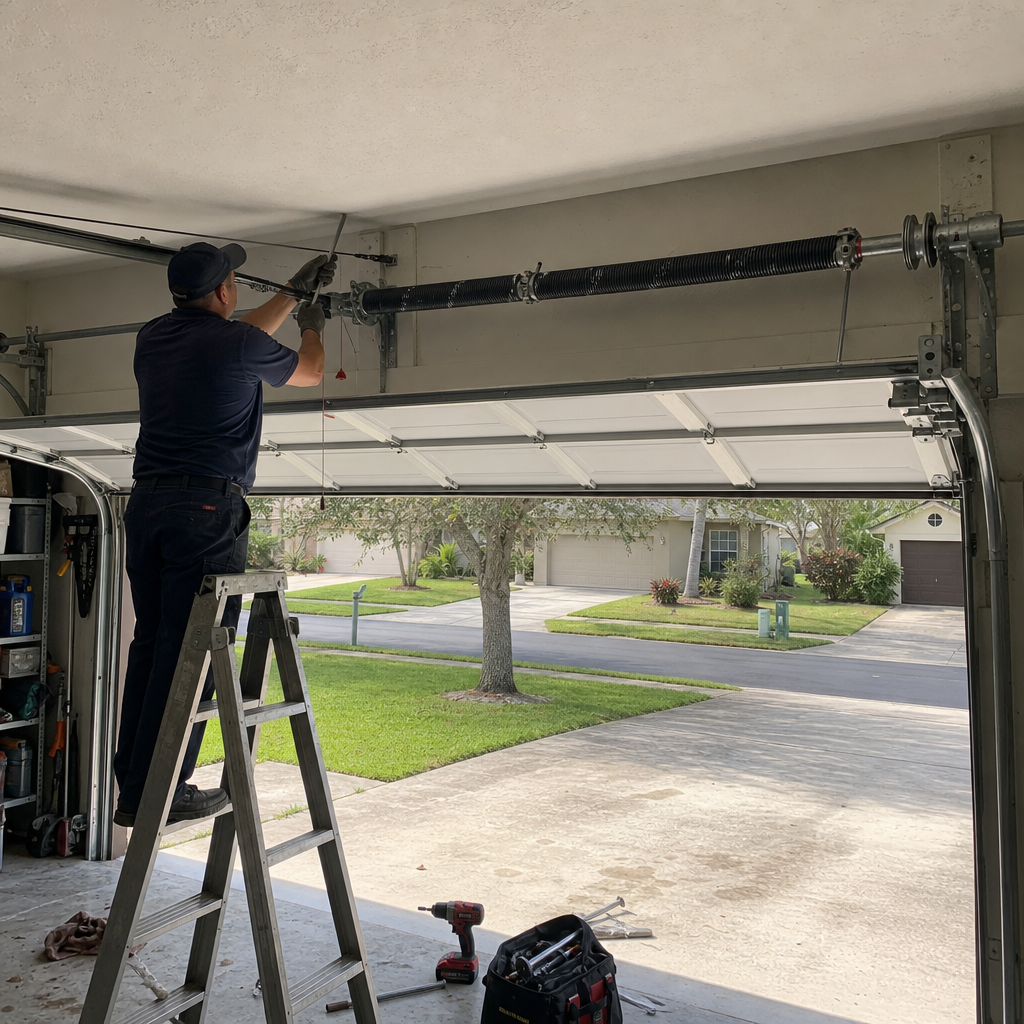
Spring fatigue accelerates in high humidity. Torsion springs are made from high-carbon steel, and steel corrodes. In a dry climate like Phoenix, that process is slow. In Orlando, where relative humidity regularly tops 90% from June through September, the oxidation cycle is relentless. We regularly see springs in Waterford Lakes and Dr. Phillips that have failed in six to eight years — well short of their rated cycle life — because surface rust had formed under the factory coating after just a few wet seasons. The fix isn’t just replacing the spring when it breaks; it’s lubricating it with a dry-film lubricant every six months to slow the process down.
Cables corrode from the bottom up. The lift cables on your door sit close to the garage floor — the wettest part of the space during Florida’s rainy season. Salt air is a secondary factor for homeowners in the eastern Orlando suburbs near Cocoa Beach access corridors, but even inland, condensation from the concrete slab wicks into the cable strands. Frayed or rust-stiffened cables are a genuine safety hazard; a snapped cable under tension can cause the door to drop suddenly. If you see any reddish discoloration along the cable length, that’s your cue to call before it becomes an emergency.
Rollers and hinges wear faster from thermal cycling. In a single July day in Orlando, your garage can swing from 78°F at dawn to over 110°F inside by early afternoon. Nylon rollers expand and contract with those temperature shifts, and cheaper-grade rollers develop flat spots within two to three years. Upgrading to sealed ball-bearing steel rollers at the time of any service call is one of the highest-value improvements an Orlando homeowner can make.
Wind-Load Ratings and Orange County Code Requirements
Florida adopted some of the strictest residential building codes in the country after Hurricane Andrew in 1992 and has continued tightening them. For Orlando homeowners in Orange County, that directly affects which garage doors are legally installable on your home — and what happens at resale or after a storm claim if yours doesn’t comply.
What “Florida Product Approval” means for garage doors. Any new garage door installed in Florida must carry a Florida Product Approval (FPA) number, issued through the Florida Building Commission. This approval certifies that the door has been tested to withstand specific wind-pressure loads. Orange County falls in the High-Velocity Hurricane Zone fringe and surrounding Wind Zones — the minimum design wind speed for most residential applications in our area runs between 110 and 130 mph depending on the specific parcel and whether it’s in an unincorporated county zone or within an Orlando municipality boundary. Your permit inspector will verify this; a door without an FPA number won’t pass.
Bracing systems matter as much as the panel rating. A door panel with an FPA rating is only part of the equation. The vertical tracks, horizontal tracks, and the spring assembly all need to be engineered as a system. We’ve seen cases in the Metrowest area where a homeowner bought a code-compliant door panel but had it installed on legacy hardware from a 1990s opening — the system as a whole would not have performed as rated in a significant wind event.
What happens after a storm inspection? If a significant storm causes damage and an insurance adjuster or county inspector finds that your garage door doesn’t meet current wind-load code, your claim can be reduced or denied, and you may be required to bring the entire opening into compliance before a certificate of occupancy is reissued. That’s not a theoretical scenario — it’s a real outcome we’ve helped Orlando homeowners navigate.
Choosing the Right Door Material for Florida
The material you choose determines how much maintenance you’ll do over the life of the door. Florida’s climate narrows the realistic options quickly.
- Steel (insulated): The most practical choice for most Orlando homes. Double-layer or triple-layer steel doors with polyurethane foam insulation resist denting, don’t rot, and don’t warp in humidity. The insulation matters more here than people think — a non-insulated steel door in a west-facing Orlando garage can radiate enough heat into the home to measurably increase cooling costs. Look at Clopay’s Coachman or Canyon Ridge lines for steel doors that carry real FPA wind ratings.
- Aluminum: Naturally rust-resistant and lightweight, making it a good fit for modern-style homes in areas like Baldwin Park or the Thornton Park adjacent neighborhoods. The trade-off is dent resistance — aluminum dents more easily than steel — and the thinner profiles offer less insulating value.
- Wood composite: A better choice than solid wood for Florida because it handles moisture cycling more gracefully, but it still requires painting or sealing every three to five years. Solid wood is not recommended for primary garage doors in Orlando’s climate; the humidity warps panels, causes paint failure, and invites the termite activity that’s endemic to Central Florida.
- Fiberglass: Won’t rot or corrode, and handles salt air well — relevant for Orlando homeowners who also own property near the coasts. The downside is brittleness in cold snaps; while Orlando rarely gets true freezes, a rare cold event can crack a fiberglass panel.
For the majority of Orlando homes, an insulated steel door from a manufacturer like Amarr or Clopay with a documented FPA approval is the lowest-maintenance, highest-performance choice over a 15-year horizon.
The Hidden Maintenance Demands of Carriage-House Doors
Drive through any subdivision built in Orlando between 2005 and 2018 — Meadow Woods, Eagle Creek, Laureate Park — and you’ll see the same door style on nearly every home: a carriage-house overlay panel on a steel sectional door. The look is popular, and the doors themselves are well-engineered. But there are maintenance realities that most owners don’t find out about until something fails.
The overlay panels trap moisture. Carriage-house overlays are decorative frames applied over the steel panel face. They create channels and pockets where Florida’s rain water and condensation accumulate. If those channels aren’t cleared and the door surface isn’t resealed periodically, the adhesive bond between the overlay and the steel panel can delaminate — especially on west-facing doors that get direct afternoon sun and rain in the same day. Inspect the seam lines of your overlay panels every spring. If you see bubbling, separation, or discoloration, address it before water gets behind the panel and accelerates corrosion on the steel beneath.
The decorative hardware adds weight unevenly. Strap hinges and door handles are part of the carriage-house aesthetic. When they’re properly installed, they’re attached to the steel panel structure. On lower-cost installations, they’re surface-mounted with short fasteners into the overlay only. Over time, the added weight — especially from heavier cast-iron-style fixtures — can pull on the overlay seams and contribute to the delamination problem above. Check that the decorative hardware feels solid when you pull it, not flexed or slightly separated at the base.
Spring balance shifts as overlays age. Carriage-house doors with full overlay kits weigh more than bare-panel doors of the same size. That additional weight is factored into the spring selection at installation. But if panels are replaced piecemeal — a common cost-cutting move — the door’s weight changes and the springs may no longer be properly balanced. An unbalanced door puts uneven stress on the opener motor, shortening its life. A balanced door should stay at any point you manually stop it; if it drifts up or down, the springs need adjustment.
Sizing a Garage Door Opener for Florida Heat
Garage door opener specifications are rated under standardized temperature conditions — typically around 70–77°F. Your Orlando garage in July does not look like that test bench. Interior garage temperatures in Central Florida regularly exceed 100°F by midday, and that heat directly affects motor performance and longevity.
Horsepower ratings are not created equal in the heat. A ½ HP chain-drive opener that performs fine in a Maryland garage may run hot and trip its thermal overload protector repeatedly in an Orlando summer, especially on a heavier insulated door. The general guidance we apply for Orlando installations: use at minimum a ¾ HP motor on any insulated steel door 16 feet wide or larger, and consider a 1 HP unit on doors over 18 feet or in garages with no ventilation. Chamberlain’s 1¼ HP belt-drive units have performed well in the heat-load conditions we see regularly in the Lake Nona and Dr. Phillips areas.
Belt-drive vs. chain-drive in Florida’s humidity. Chain-drive openers are reliable, but the metal chain is one more steel component exposed to your garage’s humid air. Over years, an unlubricated or poorly maintained chain will stretch and corrode, creating noise and inconsistent operation. Belt-drive openers eliminate that variable and run significantly quieter — an advantage if your master bedroom is above the garage, which is a common floor plan in newer Orlando construction.
DC motor openers handle heat better than AC units. DC-powered openers run cooler, offer soft-start and soft-stop functions that reduce mechanical stress, and are generally better suited to the thermal demands of Florida garages. Genie and Chamberlain both offer strong DC motor lines at mid-range price points that we’ve found hold up well to Orlando conditions.
Smart opener features worth having in Orlando. WiFi-connected openers let you check door status and close it remotely — a feature that pays for itself the first time you leave home and can’t remember whether you closed the door before a Florida thunderstorm rolls through. Myq-compatible units (found on most current Chamberlain and LiftMaster models) integrate with home automation systems and send alerts if the door has been open for a set period.
Repair vs. Replace: How to Make the Right Call
This question comes up on nearly every service call. The honest answer depends on four factors: the door’s age, the specific component that failed, the condition of the surrounding hardware, and the door’s wind-load compliance status.
Repair makes sense when:
- The door is under 10 years old and the panels are structurally sound
- A single component has failed — one spring, one cable, one roller bracket — and the rest of the hardware is in good condition
- The door already has current FPA approval and the repair doesn’t require modifying the certified assembly
- The opener is under 8 years old and the motor hasn’t shown signs of heat-related stress
Replacement makes more sense when:
- The door is 15+ years old and you’re looking at the second or third repair in 24 months
- The door does not have a current Florida Product Approval — a common situation in Orlando homes built before 2002
- Panel damage from a vehicle impact has compromised the structural integrity of the door, not just the appearance
- The door is a non-insulated single-layer steel panel in a west- or south-facing garage — replacement with an insulated door often produces energy savings that partially offset the cost
As a rough benchmark in the Orlando market, if a repair quote exceeds 50% of the installed cost of a comparable new door, most homeowners are better served by replacement. We’ll always give you that comparison directly — no pressure either way.
How to Read a Garage Door Proposal — Line by Line
The difference between a franchise chain quote and an owner-operator quote isn’t always the bottom line number — it’s what’s included. Here’s what to look for when you’re comparing proposals in Orlando:
- Florida Product Approval number: Any new door proposal should list the specific FPA number for the door being quoted. If it’s absent, ask for it in writing before signing. A door without one cannot legally be permitted in Orange County.
- Spring type and cycle rating: The proposal should specify whether the springs are standard-life (10,000 cycles) or extended-life (25,000+ cycles). In Orlando’s humidity, extended-life springs with an oil-tempered finish are worth the modest upcharge.
- Track gauge: Standard residential track is 2-inch. For heavier insulated doors or wind-load-rated assemblies, 3-inch commercial-grade track is sometimes specified. Know which you’re getting.
- Insulation R-value: If you’re buying an insulated door, the R-value should be listed. For Orlando’s climate — where you’re mostly trying to slow heat gain, not prevent heat loss — an R-12 to R-16 polyurethane-injected panel is a reasonable target.
- Who performs the installation: Franchise companies frequently dispatch independent subcontractors. Ask directly whether the person who shows up is an employee of the company or a third-party installer working on commission. Brian shows up — not a dispatcher, not a subcontractor — and that distinction matters when something needs to be done exactly right.
- Warranty terms — parts vs. labor separately: Manufacturers warrant the panel; the installer warrants the labor. Get both terms in writing. A “lifetime warranty” on the door panel doesn’t cover the spring replacement that’s needed three years later.
A Maintenance Schedule Built for Orlando’s Seasons
A generic annual maintenance schedule doesn’t account for the specific stress cycles that Orlando’s wet and dry seasons put on a garage door system. Here’s a schedule calibrated for Central Florida:
Every 6 months (March and September work well — just before and just after hurricane season):
- Lubricate torsion springs with a dry-film silicone or lithium-based spray. Avoid WD-40 — it attracts dust and strips existing lubrication over time.
- Inspect cables visually for fraying, rust discoloration, or uneven tension. Do not attempt to adjust cables yourself — they’re under significant tension and a slip can cause serious injury. Call a technician if anything looks off.
- Wipe down roller stems and apply a light lubricant to the roller bearings and hinge pins.
- Test the door’s manual disconnect and confirm it opens and closes smoothly by hand. A door that feels heavy or uneven when operated manually has a spring or balance issue.
- Check the bottom seal (astragal) for cracks or compression loss. Florida’s UV exposure degrades rubber seals faster than in northern climates — a failed bottom seal lets in rain, pests, and humid air.
Annually (September — after the end of hurricane season):
- Test the opener’s force settings: hold the bottom of the door as it closes. It should reverse with light pressure. If it doesn’t, the force setting needs adjustment.
- Inspect all panel joints and overlay seams (especially on carriage-house doors) for moisture intrusion, delamination, or paint failure.
- Check all track fasteners for looseness. Vibration from daily operation and seasonal thermal expansion can work hardware loose over time.
- Test the photo-eye safety sensors by placing a cardboard box in the door’s path. The door should reverse immediately on contact. Clean the sensor lenses with a dry cloth — Florida’s pollen season can film over the lenses enough to cause intermittent failures.
- If the door is 10 years or older, schedule a professional tune-up. Springs that have reached 70–80% of their rated cycle life in high-humidity conditions should be replaced proactively — a spring failure under tension is a genuine safety hazard.
Common Mistakes to Avoid
- Installing a non-FPA-rated door to save money. It may clear a quick visual inspection, but it won’t pass a formal post-storm review, and your homeowner’s insurance claim can be complicated or denied if the door fails in a wind event. In Orlando, this is a real financial risk, not a hypothetical one.
- Using WD-40 on garage door springs and hinges. It’s in every garage in Orlando, and it seems like the obvious choice — but WD-40 is a water displacer, not a lubricant, and it actually accelerates rust formation on torsion springs after the initial solvent effect wears off. Use a silicone or white lithium spray instead.
- Ignoring a door that’s “just a little slow.” A sluggish door in Orlando is often an early sign of spring wear, cable fraying, or an opener motor running hot. Catching it early is a $150–$250 fix; ignoring it until failure can mean a broken spring, a dropped door, or a burned-out motor — all of which cost considerably more.
- Buying the lowest-horsepower opener that technically works. Undersized openers cycle their thermal protectors frequently in Florida summer heat, dramatically shortening motor life. The upcharge from ½ HP to ¾ HP is modest at the time of installation and pays back in years of reliable service.
- Skipping the bottom seal replacement because “it doesn’t leak much.” A degraded astragal on an Orlando garage is an open invitation for palmetto bugs, moisture, and the humid air that accelerates hardware corrosion. A new bottom seal costs under $50 in parts and takes less than 30 minutes to replace.
- Accepting a proposal that doesn’t identify the installer by name. In Orlando’s garage door market, many large-brand franchises dispatch day-labor subcontractors to keep costs down. Ask who will physically be on your property — and ask for their name and whether they carry their own liability coverage.
- Replacing only one spring on a two-spring system to save money. When one spring breaks, the other is typically at the same point in its wear cycle. Replacing both at the same time costs modestly more than one but prevents a second service call — and a second spring failure — within six to eighteen months.
When to Call a Professional
Some garage door tasks are straightforward DIY: cleaning photo-eye sensors, replacing a remote battery, resealing the bottom astragal. Others are not. Call a professional when:
- A torsion spring has broken or you hear a loud bang from the spring area — springs under tension store significant energy and can cause serious injury if handled without proper tools and training.
- A lift cable has snapped or appears frayed — a door hanging by one cable can drop without warning.
- The door has come off the tracks, either from an impact or a hardware failure.
- The opener runs but the door doesn’t move, or moves unevenly — this often indicates a stripped gear or a balance problem that requires hands-on diagnosis.
- You’re buying a new door and need to confirm FPA compliance before permitting.
- You’re preparing a home for sale and need documentation that the door assembly meets current Orange County code.
Majestic Garage Door Repair Orange County offers free estimates in Orlando — call (863) 588-3313. Brian Johnson has 18 years of fixes behind him, so yours goes right the first time.
Frequently Asked Questions
Most common repairs in Orlando — single spring replacement, cable replacement, roller swap, or opener tune-up — fall in the $150 to $350 range for parts and labor. A broken torsion spring replacement on a standard two-car door typically runs $200–$280 when both springs are replaced at the same time, which we always recommend. Full opener replacements run $350–$650 installed depending on horsepower and drive type. These ranges reflect the Orlando market as of 2025; emergency or after-hours calls may carry an additional service fee. Call (863) 588-3313 for an exact quote — estimates are free.
Yes. Any garage door installed in Orange County under a permit must carry a Florida Product Approval number certifying it meets the minimum wind-load design pressure for your specific location. The required rating varies by parcel — most Orlando residential zones require a door engineered for 110–130 mph design wind speed. A door installed without FPA approval won’t pass inspection and may complicate insurance claims after storm damage. Call (863) 588-3313 if you’re not sure whether your current door is compliant.
Standard torsion springs are rated for approximately 10,000 open/close cycles — roughly seven to ten years at average use. In Orlando, high humidity and heat cycling can shorten that lifespan to six to eight years, particularly on springs without a corrosion-resistant coating. Extended-life springs rated at 25,000+ cycles last closer to 15 years even in Florida conditions and are worth specifying when replacing springs on a door you plan to keep. In Waterford Lakes and similar neighborhoods with active households running three to four cycles per day, we routinely see standard springs fail in the six-year range.
It can, and it does — more often than most homeowners realize. When a motor runs hot, it trips an internal thermal overload protector, and the opener appears “dead” until it cools down. This is most common on undersized motors (½ HP or less) driving heavy insulated doors in garages with no ventilation, during the peak heat of July and August. If your opener stops working mid-afternoon on a hot day but works fine in the evening, thermal overload is the likely cause. Upgrading to a ¾ HP or 1 HP DC motor usually solves the problem permanently.
Both are sectional doors that operate the same way mechanically — they roll up on horizontal tracks. The difference is purely cosmetic: carriage-house doors have decorative overlay panels, faux strap hinges, and handles applied to the face of the steel sections to mimic the look of traditional swing-out barn doors. In Orlando’s newer subdivisions, the carriage-house style is extremely common. The maintenance difference is that the overlay panels and decorative hardware create additional moisture-trapping seams that require periodic inspection and resealing, especially after the wet season.
At 12 years, the door panel itself is likely in reasonable shape if it’s steel and has been maintained, but the mechanical components — springs, cables, rollers — are probably past the midpoint of their service life in Florida’s climate. If you’re facing a single spring or cable repair, doing it makes sense. If you’re looking at multiple failing components simultaneously, or if the door doesn’t carry a current FPA approval, replacement delivers better long-term value. A new insulated door also improves the garage’s thermal performance noticeably, which matters in Orlando’s cooling-dominated climate. Call (863) 588-3313 and we’ll walk through the numbers with you honestly — no hard sell either way.
The Bottom Line
Orlando’s humidity, hurricane code requirements, and heat load make garage door ownership meaningfully different here than anywhere else in the country. Choosing a door with an FPA approval, specifying corrosion-resistant hardware, sizing your opener for Florida temperatures, and running a biannual maintenance schedule aren’t optional extras — they’re what separates a door that lasts 18 years from one that needs a major repair every two. Whether you’re in Garage Door Repair in Williamsburg territory or another part of the Orlando metro, the principles in this guide apply. If you need Garage Door Installation in Williamsburg or want to explore Garage Door Opener in Williamsburg options, Brian Johnson and the Majestic Garage Door Repair team are ready to help. Get it right once, and you’ll get a decade or more of reliable, code-compliant service in return.
Ready to Talk to Someone Who Actually Knows Orlando Garage Doors?
Brian Johnson has spent 18 years working on garage doors across Orlando — from the carriage-house overlays in Laureate Park to the older double-car setups in Dr. Phillips and the post-hurricane retrofits in Metrowest. Majestic Garage Door Repair Orange County carries parts for every major brand on the market, including Chamberlain, Genie, Clopay, and Amarr, and Brian personally handles or directly oversees every job — no subcontractors, no guesswork. With 213 verified five-star reviews and a perfect 5.0 rating, the track record speaks for itself.
Call (863) 588-3313 for a free estimate. Same-day and emergency service is available for Orlando homeowners who can’t wait.
Written by Brian Johnson, Owner & Lead Technician at Majestic Garage Door Repair Orange County, serving Orlando since 2008.